You know how it is: The proposal is sent out. Days pass. Then weeks. Eventually, you get a rejection—or worse: no response at all. Your sales resources are tied up, your calculations are pointless, and the competition is overtaking you.
In B2B, it's not only the best product that wins. Success comes to those who structure, argue, and follow-up on their proposals in a way that allows decision-makers to say yes quickly. In this article, we present 9 practical strategies to help you close deals faster—from structuring to price argumentation to a smart follow-up strategy.
Why B2B Offers Work Differently Than B2C
In B2C, a straightforward price and a call-to-action often suffice. In B2B, however, you’re dealing with longer decision processes, multiple stakeholders, and complex requirements. A B2B proposal is not just a price list—it's a strategic document that builds trust, minimizes risks, and makes benefits tangible.
The three biggest mistakes in creating B2B proposals:
Lack of structure: The client has to sift through blocks of text to grasp the core message.
Weak arguments: It describes what will be delivered—but not why it matters to the client.
No follow-up plan: The proposal is sent, and then they wait passively.
Avoiding these mistakes measurably increases your closing rate. According to a Gartner study (2025), 44% of B2B buyers abandon the purchasing process because they feel overwhelmed or lack a clear basis for decision-making. This is exactly where the following 9 strategies come into play.
Strategy 1: The Right Proposal Structure – Clarity Beats Creativity
A good B2B proposal follows a clear, recognizable structure. Decision-makers want to understand the essence immediately—without having to search extensively.
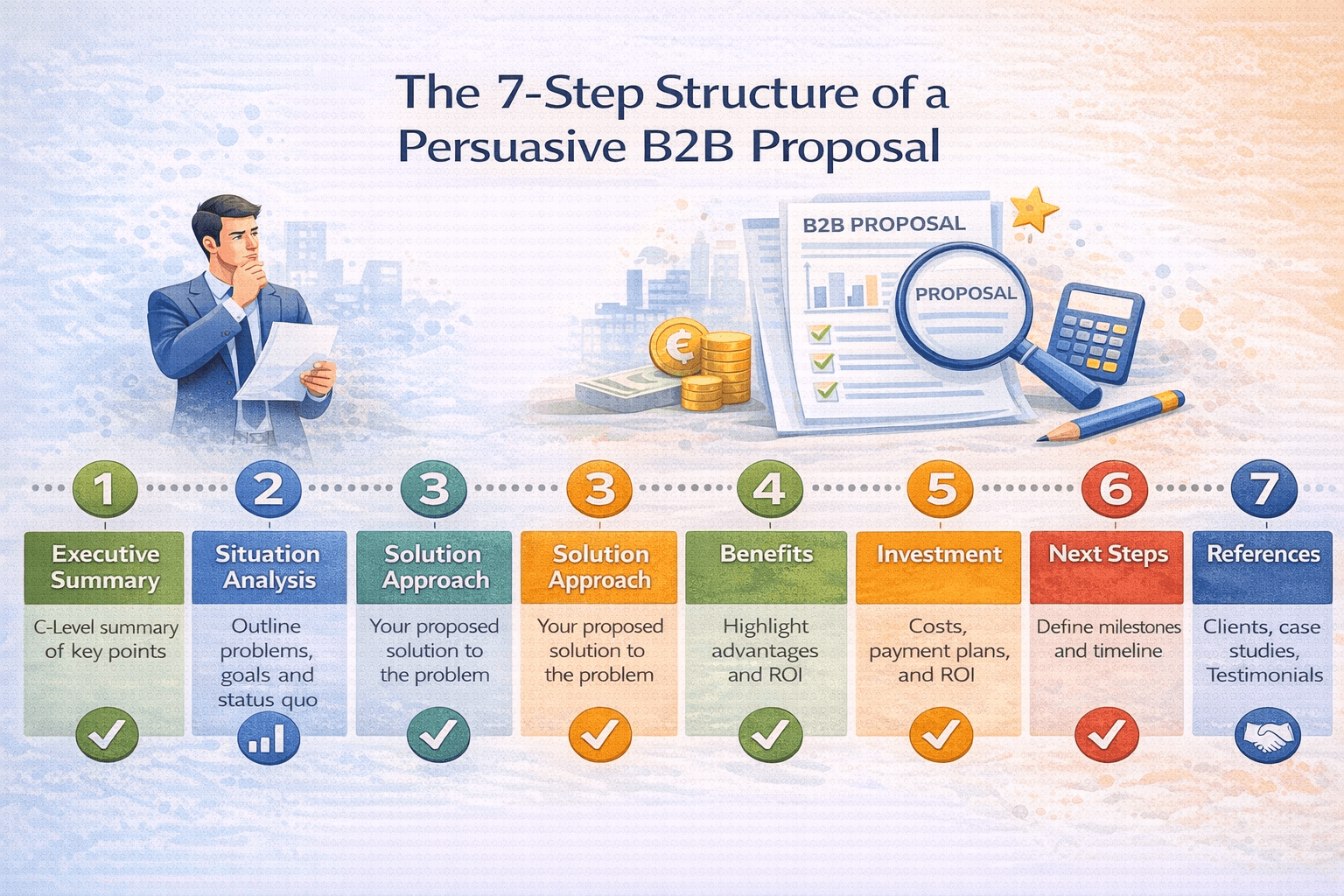
Proven Structure for B2B Proposals:
1. Executive Summary (1–2 paragraphs)
Summarize the client's problem, your solution, and the main benefits. This section is aimed at the management, who often read only this part.
2. Situational Analysis & Understanding of Needs
Show that you understand the client's challenge. Use phrases like: “As discussed, you are facing the challenge of..."
3. Solution Approach & Scope of Services
Describe what you will deliver—structured in modules or phases. Use bullet points instead of blocks of text.
4. Benefits & Added Value
Translate each service into a concrete advantage: “By integrating your ERP system, you reduce manual order processes by 70% and save about 120 working hours monthly."
5. Investment & Pricing Model
Present the price transparently—ideally with justification (see Strategy 4).
6. Next Steps & Timeline
Give the client clear action instructions: “To go live by the end of Q2 2026, we need your approval by March 15."
7. References & Social Proof
Include short success stories or the logos of existing clients (if permitted).
Strategy 2: Benefits Over Features – Speak the Decision-Maker's Language
Technical details interest the purchasing department. The management wants to know: What does this concretely do for me?
Before (Feature-focused):
“We will implement a Shopware 6 system with PIM connectivity and automated order processing."
After (Benefit-focused):
“With the new system, your customers can order around the clock—without waiting times. This relieves your sales team and increases revenue by an average of 20–30% in the first year."
Practical Tip: Use the “So that" formula:
“We integrate your ERP system, so that all orders are processed automatically and you no longer need manual entries."
Strategy 3: Reduce Risk – Build Trust Through Transparency
B2B decision-makers fear making wrong decisions. Especially with digitization projects. Addressing this fear is key to building trust.
Strategies to Minimize Risk:
Phased Model Instead of Big Bang
Offer an MVP (Minimum Viable Product): “We start with a functional basic shop in 6 weeks. We then expand step by step."
Money-Back Guarantee or Success Guarantee
“If we do not achieve the defined KPIs after 6 months, we will refund 50% of the setup costs."
Transparent Communication
Openly name potential challenges: “Integration of your legacy ERP system may take 2–3 weeks longer. We have included a buffer for this."
Strategy 4: Price Argumentation – Investment Instead of Cost
“Too expensive" is the most common objection in B2B. But often the issue is not the price, but the lack of justification.
How to Argue Prices Convincingly:
1. Compare with Alternatives
“Building an internal e-commerce department costs you about €500,000 annually (salaries, tools, recruiting). With our model, you get the same service for €10,000 monthly—with immediate availability."
2. Show the ROI
“With an additional online revenue of €2 million per year, the investment pays off after just 6 months."
3. Present Pricing Models Transparently
Offer options (e.g., Basic, Professional, Enterprise) so the client can decide for themselves.
4. Avoid Discount Battles
Discounts signal: “My offer was overpriced before." Better: Show added value or offer additional services.
Strategy 5: Options Instead of Either-Or – The Power of Choice
People prefer making decisions between options rather than between yes and no. Use this.
Example:
Option 1: Basic Package (€20,000 Setup + €8,000/Month)
MVP shop, basic marketing, operation
Option 2: Professional Package (€30,000 Setup + €12,000/Month)
Extended functions, marketplace connections, SEO/SEA
Option 3: Enterprise Package (€50,000 Setup + €18,000/Month)
Comprehensive solution including internationalization, PIM integration, dedicated account manager
Psychological Effect: Most customers choose Option 2 (Professional)—because they don’t want “too little" and not “too much". Yet, they feel they have made their own decision.
Strategy 6: Creating Time Pressure – Without Manipulation
Proposals without a deadline tend to get lost. But blunt pressure (“Offer only valid until Friday!") seems unprofessional.
Respectable Ways to Create Urgency:
1. Project-Based Deadlines
“To achieve your goal—going live before the peak season in September 2026—we need your approval by April 30, at the latest."
2. Highlight Capacity Constraints
“Our next available project slot starts on May 1. The next opening wouldn’t be until August."
3. Demonstrate Market Changes
“Your competitors are massively building digital sales channels. Every month of delay means lost market share."
Strategy 7: Follow-Up – The Art of Following Up
Most deals don’t fail because of a “no," but due to a lack of follow-up. Studies show: 80% of sales require 5–12 contact points—yet most sales teams give up after the second attempt.
Follow-Up Strategy in 4 Steps:
Day 3 After Dispatch:
“Have you had a chance to review our proposal? Are there any open questions I can clarify?"
Day 7:
Offer additional value: “I have attached a case study of a similar project—it might help with your decision."
Day 14:
Ask about specific concerns: “Is there anything that is still holding you back? I can adjust the proposal to suit your needs."
Day 21:
Set a final deadline: “I want to ensure we can start your project on time. Can we make a decision by the end of the week?"
Important: Remain professional, not intrusive. Your stance should be: “I want to help you make the right decision"—not “I want to sell."
Strategy 8: Anticipate Objections – Before They Arise
The best proposals address objections, before the client voices them.
Typical B2B Objections and Your Responses:
“Too expensive"
→ Compare with alternatives (see Strategy 4) and show the ROI.
“We don't have time for a project"
→ “Precisely why we handle the entire implementation. Your effort: 2 hours per week for coordination."
“We need to review this internally"
→ “Absolutely. What further information do you need to make an informed decision?"
“We want to gather more offers"
→ “Perfectly understandable. I’d be happy to assist in comparisons. What do you prioritize?"
“Our industry is unique"
→ “After over 2,500 projects, we’ve learned: Every industry has its nuances—but successful digitization follows proven principles. Let’s discuss your specific requirements together."
Strategy 9: Personal Touch – People Buy from People
Even in B2B, the rule holds: trust is built between people, not companies.
Ways to Add Personality to Your Proposal:
1. Customization Instead of Mass Production
Avoid copy-paste proposals. Refer specifically to conversations: “As you mentioned, your biggest challenge right now is..."
2. Video Message Rather Than PDF
Besides the written proposal, send a short video (2–3 minutes) where you personally explain the key points.
3. Direct Contact Person
“You can reach me directly anytime at [phone number]. I’ll be happy to take time for a personal discussion."
4. Authenticity
Show that you are not just looking to sell but are genuinely interested in solving the client's problem.
Common Mistakes When Creating Proposals – and How to Avoid Them
Even experienced sales teams frequently make the same mistakes. Here are the most common ones:
Mistake 1: Too Much Text, Too Little Structure
→ Solution: Use bullet points, tables, and visual elements.
Mistake 2: Proposal Without Context
→ Solution: Start with a situational analysis showing that you understand the client.
Mistake 3: Price Without Justification
→ Solution: Explain why the price is justified—through ROI, comparisons, or added value.
Mistake 4: No Clear Next Steps
→ Solution: Provide the client with a concrete action plan.
Mistake 5: Passive Waiting After Dispatch
→ Solution: Plan your follow-up in advance (see Strategy 7).
Practical Example: What a Convincing B2B Proposal Looks Like
Imagine: A mid-sized manufacturer of industrial components seeks an e-commerce solution. The sales director is concerned about costs and complexity.
Your proposal could be structured like this:
Executive Summary:
“You want to digitalize your sales without building an expensive internal team. With our CP-One model, you get a complete e-commerce department—from strategy to technology to marketing. Initial sales are possible within 6 weeks."
Situational Analysis:
“As discussed, your customers currently order by phone and fax. This ties up capacities and makes scaling difficult. At the same time, your customers are increasingly demanding digital ordering options."
Solution Approach:
MVP shop with your top 100 products (go-live in 6 weeks)
ERP integration for automated order processing
SEO & Google Ads for initial visibility
Monthly reporting with clear KPIs
Benefits:
Relief of your sales team by approx. 30%
Opening up new markets without additional field sales force
Scaling without exploding fixed costs
Investment:
€20,000 Setup + €10,000/Month (with a 24-month term)
→ Comparison: An internal department would cost about €500,000/year.
Next Steps:
“For a go-live in May 2026, we need your approval by March 20. I will call you on Wednesday to clear up any questions."
How to Systematically Improve Your Proposals
The 9 strategies are not a one-time recipe—they work best when applied and optimized continuously.
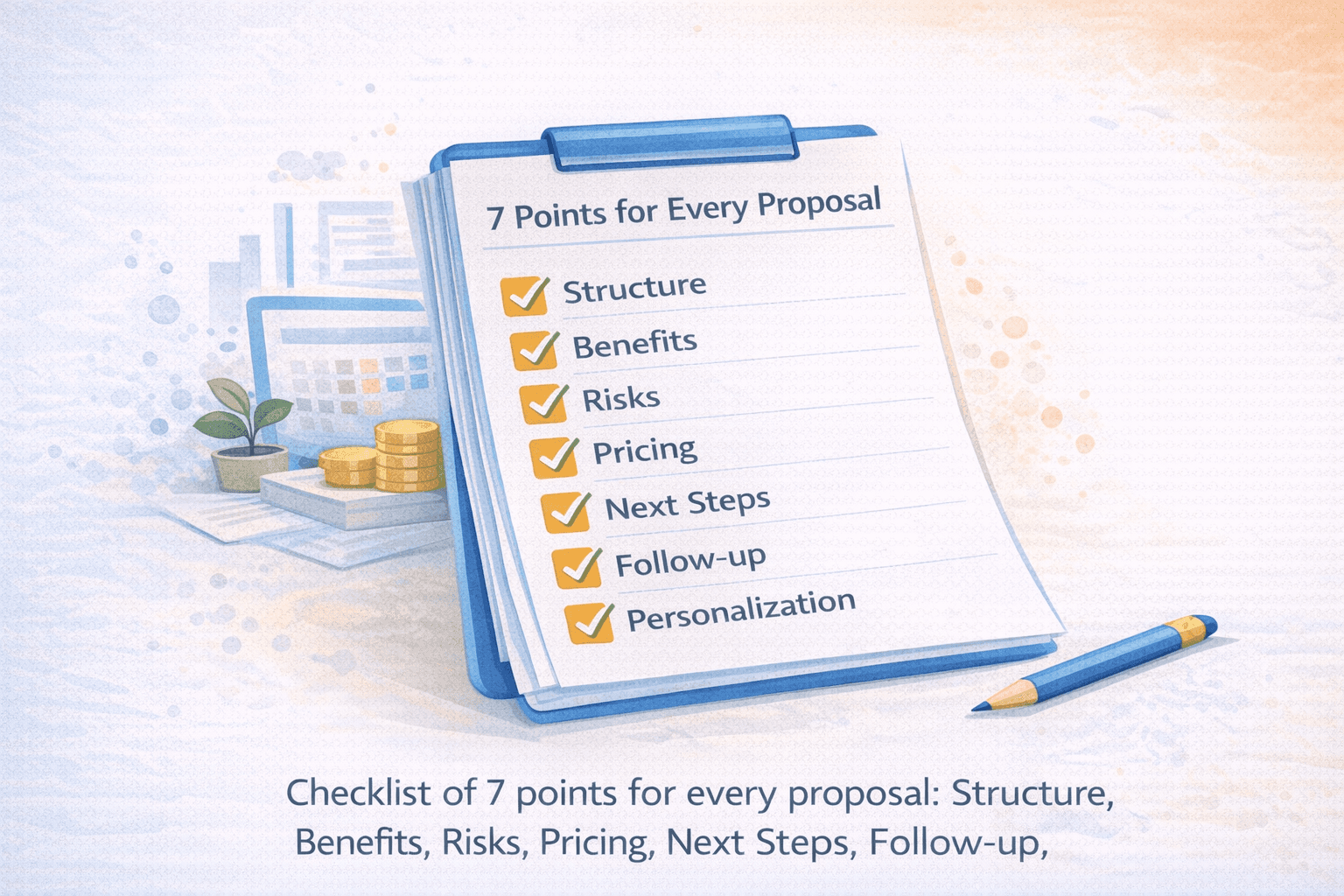
Checklist for Every Proposal:
Is the structure clear and scannable?
Have I highlighted the client’s benefits?
Are risks addressed and minimized?
Is the price logically justified?
Are there clear next steps?
Do I have a follow-up plan?
Does the proposal feel personal and tailored?
Tip: Regularly analyze your proposals: Which were accepted, which were rejected? Where were questions raised? Use these insights to improve your templates.
The Role of Trust and Expertise
In B2B, decision-makers don't just buy a service—they buy security. Security that the project will succeed. That the service provider is reliable. That the investment is worthwhile.
Having been active in e-commerce for over 25 years and managing more than 2,500 projects, we bring precisely this security. At Commerce Partner B.V., we understand that mid-sized manufacturers and wholesalers need practical solutions that work—not theoretical concepts.
Our clients value that we not only consult but also implement. That we make risks transparent and find solutions together. And that we deliver measurable results—not just promises.
Conclusion: Proposals Are Sales Conversations in Written Form
A good B2B proposal is more than a document—it’s a strategic tool that builds trust, conveys benefits, and accelerates decision-making.
The 9 strategies in this article help you design your proposals in a way that decision-makers can say yes more quickly:
Clear Structure – Clarity Beats Creativity
Benefits Over Features – Speak the Decision-Maker's Language
Reduce Risk – Build Trust Through Transparency
Price Argumentation – Investment Instead of Cost
Offer Options – The Power of Choice
Create Time Pressure – Without Manipulation
Follow-Up – The Art of Following Up
Anticipate Objections – Before They Arise
Personal Touch – People Buy from People
Implement these strategies consistently, and you’ll find: your closing rate will rise, your sales cycles will shorten, and your clients will feel better served.
What experiences have you had with B2B proposals? Which strategy made the biggest difference for you? We look forward to your feedback.
FAQ – Frequently Asked Questions
How to write a convincing B2B proposal?
A convincing B2B proposal follows a clear structure: executive summary, situational analysis, solution approach, benefits, investment, and next steps. It's crucial to emphasize the benefit to the client and to address risks transparently. Personal engagement and concrete action recommendations significantly increase the chance of acceptance.
How to respond to the ‘too expensive’ objection in B2B?
Compare your solution with alternatives and demonstrate the ROI. For example: ‘Building an internal department costs €500,000 annually—our model delivers the same service for a fraction, with immediate availability.’ Avoid discount wars; instead, offer value or additional services.
How often should one follow up on a proposal?
Plan at least 4–5 contact points: after 3, 7, 14, and 21 days. Studies show that 80% of B2B sales require 5–12 contacts. Stay professional and offer additional value at each follow-up, such as a case study or clarification of open questions.
What structure is best for B2B proposals?
A proven structure includes: executive summary, situational analysis, solution approach with scope, concrete benefits and added value, transparent pricing model, clear next steps, and references. Use bullet points instead of text blocks and keep paragraphs short for better readability.
How to reduce risks in a B2B proposal?
Offer phased models instead of big-bang projects, communicate transparently about potential challenges, and incorporate success guarantees or money-back options. References and case studies build additional trust. Show that you know the risks and have solutions for them.
Conclusion
In B2B, proposals are not accidental—they are the result of strategic planning, clear communication, and consistent follow-up. The 9 strategies from this article provide a proven framework to measurably increase your closing rate.
The key is to view proposals not as static documents but as a living part of your sales process. Structure clearly, argue benefit-oriented, reduce risks, and keep following up—then prospects become customers.
The digital transformation in B2B sales will continue to accelerate in the coming years. Companies that professionalize their proposal processes and focus on speed will gain a decisive competitive advantage.
Do you have questions about any of the strategies? Do you want to put your proposal strategy to the test? We look forward to discussing it with you.
Do you want to digitalize your sales processes and make your proposals systematically more successful? Schedule a non-binding strategy discussion with our e-commerce experts. Together, we’ll analyze your current situation and show you concrete optimization potentials—free of charge and obligation-free.