The IT manager says: “Our ERP can't do that.” The Shopware partner asks: “What interface does your ERP have?” And the e-commerce manager is stuck in the middle — and knows: both are right, but no one has delivered a solution.
This is the reality in many mid-sized manufacturing companies. The ERP system — whether SAP, proALPHA, abas, PSIpenta or an industry-specific solution — works very well for production, materials management and financial accounting. But for B2B e-commerce? No shop connection. No real-time stock levels for the webshop. No automated order transfer. And interface documentation that was last updated in 2014.
The classic answer: “Then we build a custom interface.” That takes months, costs five figures — and lasts until the next ERP update. The other answer: “Then we switch the ERP.” That takes years and costs seven figures.
There is a third way. That is exactly what we implement at Commerce Partner for manufacturers and wholesalers in the mid-market.
The problem: Why industrial ERPs and B2B e-commerce do not fit together
An ERP system built for manufacturing thinks in bills of materials, work schedules and cost centers. A B2B online shop thinks in baskets, customer sessions, real-time availability and checkout flows. Connecting these worlds is not a configuration task — it is an architecture problem.
Specifically, this shows up in five typical bottlenecks we know from more than 25 years of project experience: pricing (customer-specific online prices and tiered pricing are missing), inventory (no real-time translation into the shop format), orders (manual re-entry by customer service), product data (technical master data without e-commerce attributes) and customer data (completely different data models in the ERP vs. the shop).
The solution: Reybex as the e-commerce layer between ERP and Shopware
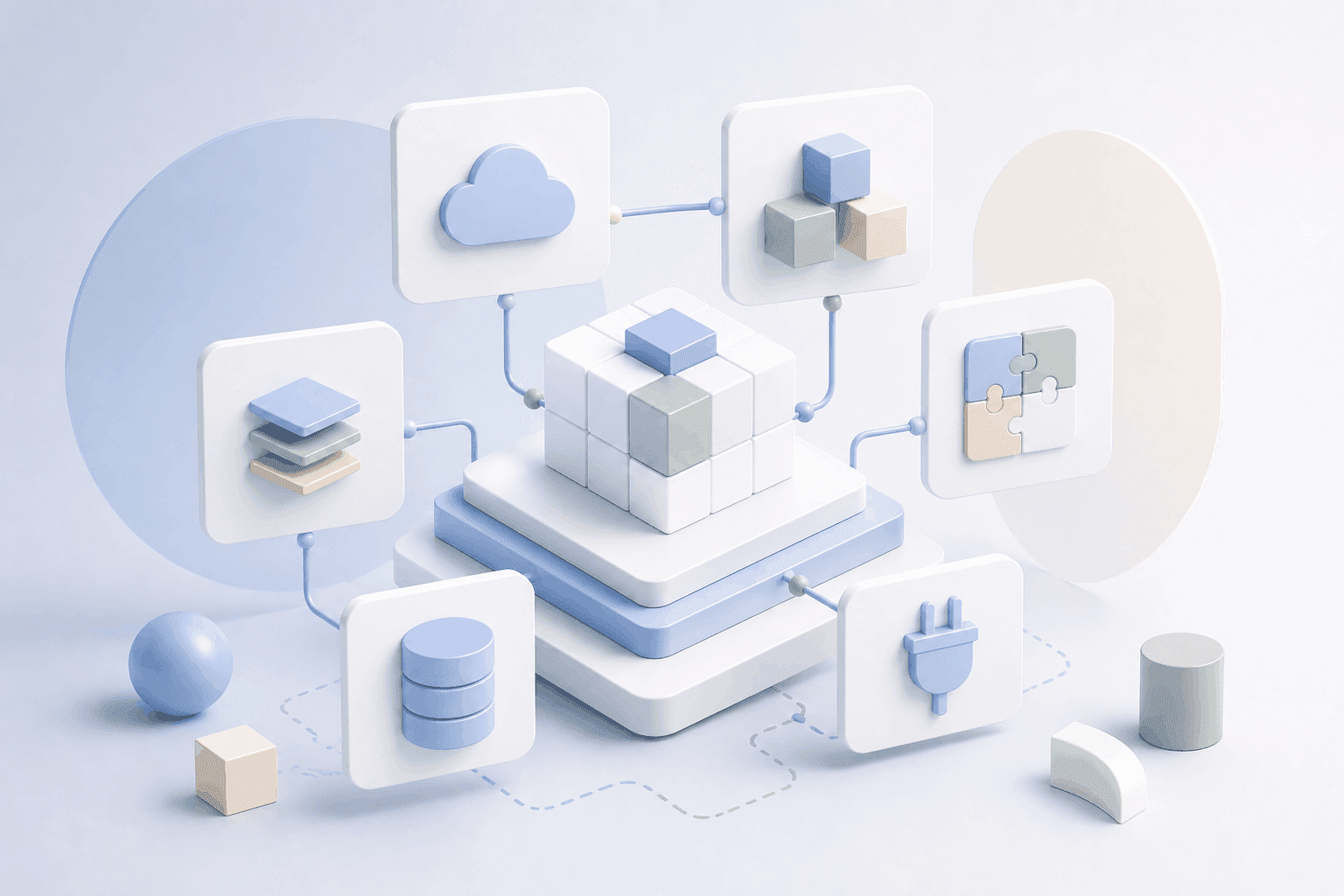
Instead of bending the manufacturing ERP or building an expensive custom interface, we use a two-ERP architecture in this scenario: the existing ERP stays where it is — and for the e-commerce channel we add a second, lightweight system: Reybex.
Reybex is a cloud ERP developed specifically for e-commerce and multichannel retail. It comes with native interfaces to Shopware, marketplaces (Amazon, Otto, eBay, Kaufland) and shipping providers. At the same time, it has an open API that enables data exchange with the existing industrial ERP.
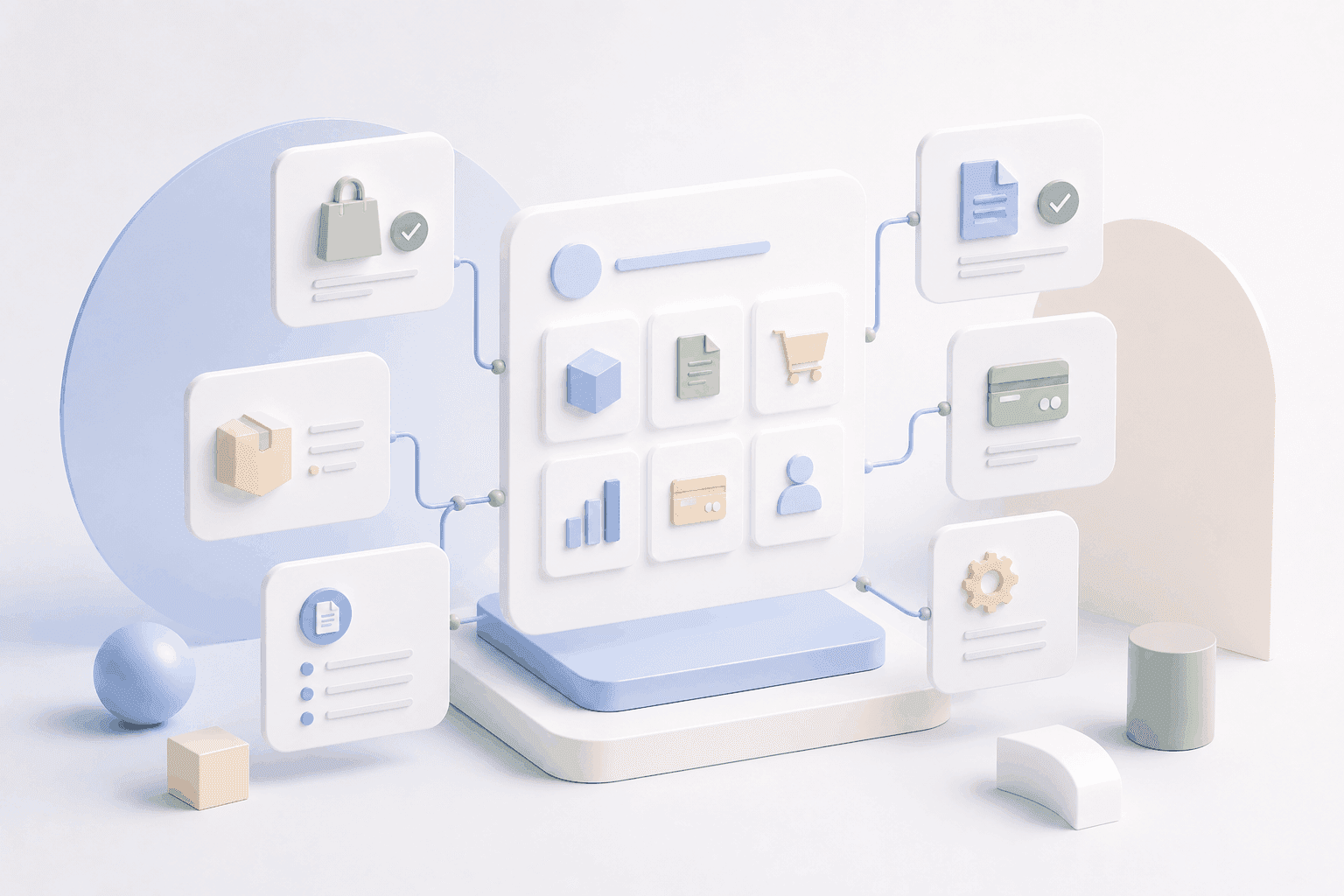
The result: Reybex becomes the translator between the production world of your ERP and the commerce world of Shopware. It takes the data that the industrial ERP can provide (master data, inventory, prices), translates it into e-commerce-ready formats and synchronizes it with Shopware. In the other direction, orders from the Shopware shop flow back to Reybex, are processed there as orders, and — depending on the setup — are passed on to the industrial ERP as customer orders.
The architecture: What flows where
From the industrial ERP to Reybex: What is synchronized
Item master data (material numbers, descriptions, weights, units), stock levels, base prices, customer master data (customer account numbers, payment terms) — depending on the ERP via API, CSV export/import or a dedicated middleware. The frequency depends on the use case: master data often daily, stock levels several times a day or in real time.
What Reybex does with it: Item master data is enriched with e-commerce data — description texts, images, categories, variants, shop-specific prices. Stock levels are converted into a unified availability model. Customer prices and terms are prepared for the Shopware shop.
From Reybex to Shopware: What your customers see
Complete product data (including texts, images, prices, stock levels, variants), customer data, order status — via the native Reybex-Shopware connector, automatically in real time or at configurable intervals. What the B2B customer sees in the Shopware shop: current stock, their individual prices, correct delivery times — without the industrial ERP having to communicate directly with Shopware. The Shopware connection runs through a ready-made connector, and the ERP side uses standard export formats.
Why this architecture convinces manufacturers and wholesalers
The industrial ERP remains untouched. You do not need an ERP migration project, new licenses for the existing system, or months of customization work.
Time to market in weeks, not years. Six weeks to the first visible result, twelve weeks to productive operation is realistic. No comparison to an ERP migration project that takes 18–24 months.
Multichannel from day one. In addition to Shopware connectivity, Reybex also comes with ready-made integrations for Amazon, eBay, Otto and Kaufland. Stock, prices and orders are synchronized across all channels — controlled from one system.
E-commerce processes that the industrial ERP does not know. Reybex handles processes that are not intended in an industrial ERP: printing shipping labels, sending tracking numbers back to the shop, processing returns, reconciling incoming payments, creating picking lists with route optimization.
Scalable and ERP-independent. If your company grows, the ERP changes or a second shop is added — Reybex remains the stable e-commerce layer. Dependence on the industrial ERP is reduced, not increased. If you ever move to a more modern ERP, the e-commerce channel does not have to be rebuilt.
What your B2B customers get from it
Real-time stock in the shop. No “Please ask for availability” — just a clear number. Reybex takes the stock from the industrial ERP and passes it to Shopware. Customer-specific prices after login. Not the list price, but the actual price for exactly this customer — maintained in Reybex, synchronized to Shopware. Self-service in the B2B customer portal: repeat orders, invoice download, delivery status — without a call, without an email, because the data from Reybex arrives automatically in the shop. Relief for customer service: no more manual order entry, no stock follow-up questions, no invoice sending by email. The processes that used to run manually now run automatically.
When this solution fits — and when it does not
This two-ERP architecture is a fit if your industrial ERP has no documented shop interfaces or the existing interfaces are not enough for B2C/B2B e-commerce, if you want to build the e-commerce channel without starting a million-euro ERP project, if your customer service team currently transfers online orders into the ERP manually, if you also want to sell through marketplaces alongside your own Shopware shop and need central control, or if your e-commerce team should be able to operate independently of the IT department.
This solution is less suitable if your industrial ERP already comes with complete, stable e-commerce integration, if you are planning an ERP change anyway and the timing is less than twelve months away, or if your business model is exclusively B2C with standard price lists (that is, no customer-specific prices or terms).
The path to setup: Not a mammoth project
The two-ERP architecture sounds complex. In practice, the opposite is true — because the complexity on the industrial ERP side is not increased at all. The project is divided into three phases:
Phase 1 (weeks 1–3): Data analysis and interface design. Which data comes from the industrial ERP? In what format? How often? What does Reybex need to enrich? What goes on to Shopware? The result is a clear data-flow diagram.
Phase 2 (weeks 3–8): Reybex setup and Shopware connection. Reybex is configured, the Shopware connector is activated, product data is imported and enriched, pricing logic is set up, test orders are run.
Phase 3 (weeks 8–12): ERP connection and go-live. The interface to the industrial ERP is set up and tested. Stock flows, orders are synchronized, the shop goes live.
The right question to ask yourself now
Not: “Can our ERP do e-commerce?” — because you probably already know the answer.
But: “How quickly can we build our digital B2B sales without risking our ERP?”
The answer: faster than you think. With an architecture that respects your existing system, adds an e-commerce-ready layer and gives your B2B customers what they expect: a shop that works.
You can learn more about Reybex here: Reybex at Commerce Partner
About Commerce Partner
Commerce Partner supports manufacturers and wholesalers in the mid-market in building digital B2B sales — from strategy to ongoing operations. We implement the combination of Reybex and Shopware for companies whose industrial ERP was not built for e-commerce. From architecture planning to Reybex configuration to the Shopware-based B2B customer portal, we build the bridge between your production world and your digital sales.
Contact us — we will show you in a short initial conversation whether the two-ERP architecture fits your situation and how quickly you can go live.