Why furniture manufacturers need to connect their dealers digitally now
Today, if a furniture manufacturer is growing, they're doing it not in spite of commerce, but with it. But only if their sales operations are digitally well-established.
Furniture works online. The only question is who benefits.
Online sales of furniture have been growing for years—not only in the consumer segment but also in B2B, covering office furniture, project fittings, and installation systems for businesses and hospitality. Customers are willing to buy, configure, and order high-priced products online. Fear of buying online has largely disappeared in this segment as well.
This sounds like good news for furniture manufacturers. And it is, but only for those who have structured their sales operations accordingly. The market is moving digitally, but the internal processes of many mid-sized manufacturers are not.
If a manufacturer doesn't control how their products are represented in commerce, they lose out exactly when the market picks up. Not due to poor products, but due to poor visibility.
The real issue: What happens between manufacturer and end customer
Many mid-sized furniture manufacturers know this scenario. They supply high-quality products to 30, 50, or 100 specialized retailers. They have a field sales team visiting retailers regularly, bringing catalogs and maintaining relationships. This has been working for decades.
But today's question is different: What happens to these products when a potential buyer searches online?
In practice, it often looks like this: A purchasing manager looks for office furniture for a new office. They use Google, compare, and click on retailer sites. What they find are outdated product images from the 2021 catalog, incomplete variant descriptions, and missing dimensions. Sometimes the retailer has the product in stock but no online presence for it.
Result: The purchasing manager buys elsewhere. Not because the product was worse, but because a competitor was simply easier to find and better presented.
This is not a retailer problem. It is a structural problem, and it is the manufacturer's responsibility to solve it.
Why traditional sales is reaching its limits
The classic sales path via field sales, trade shows, and print catalogs has long worked well. It built relationships, placed assortments, and generated sales. But it has a structural weakness: It is not scalable, and it does not provide data.
When a field sales rep visits a retailer, the best they can do is ensure the retailer knows and is motivated to sell the new range. What they can't control is how the retailer presents products online, whether prices are up-to-date, or if orders are processed quickly.
Additionally, there is effort on both sides. Retailers who place orders by phone, request price lists by email, and enter product data manually spend significant time on processes that could be automated. Field sales reps answer routine questions instead of focusing on strategic tasks.
This costs time, money, and leads to errors. And it prevents both sides from focusing on what they should be doing.
What a B2B portal can do that traditional sales never could
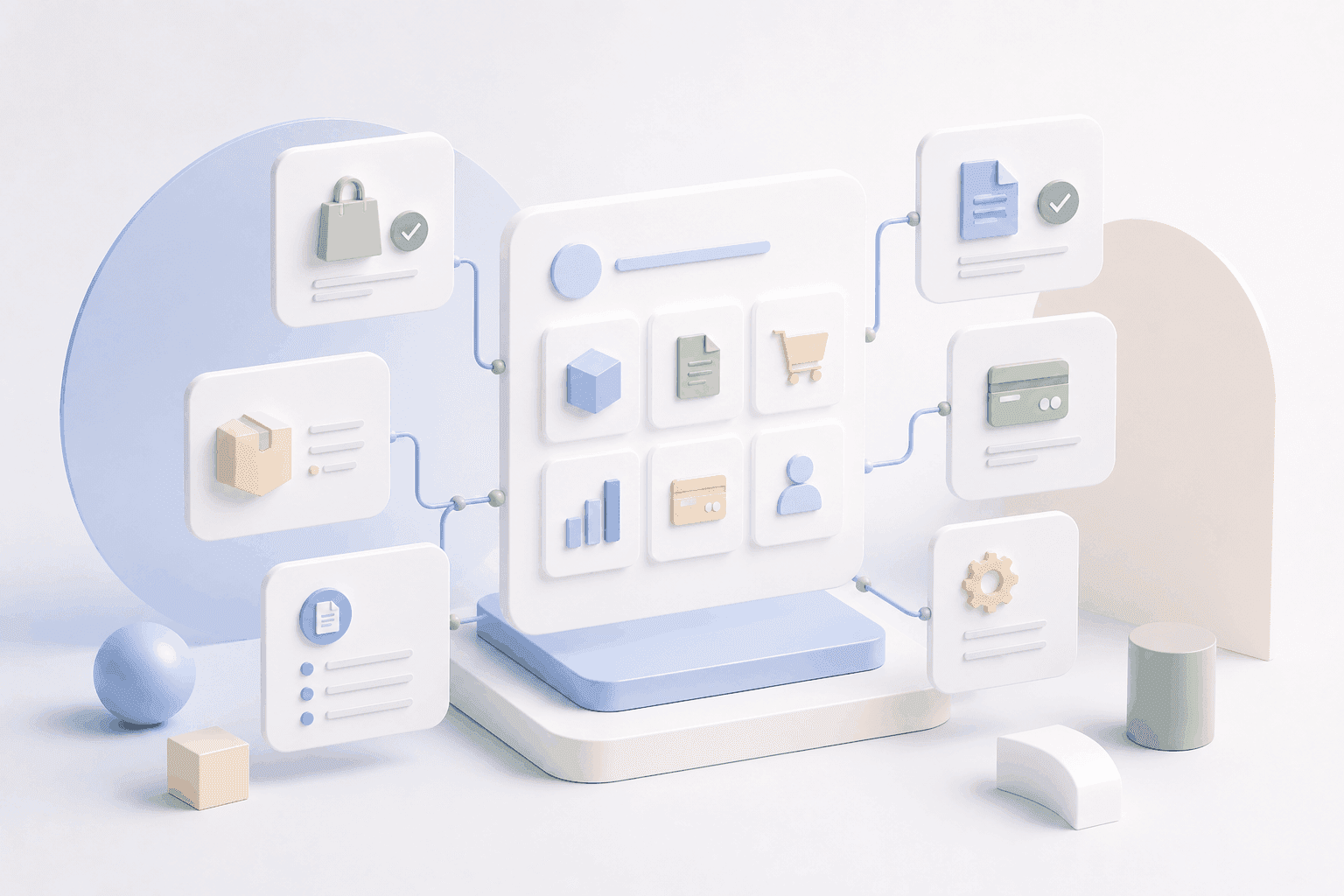
A digital B2B portal is not an online shop for end customers. It is the digital sales hub between manufacturers and trade. A platform where retailers can work independently while manufacturers maintain control.
What this means in practice:
Real-time product data. Retailers always see current prices, variants, availability, and product descriptions. No manual reconciliation, outdated PDF catalogs, or misunderstandings during order negotiations. If the manufacturer introduces a new product or changes a variant, it’s immediately visible to all retailers.
Individual terms per retailer. Each retailer sees only their assortment on their terms. Discount programs, retailer groups, regional price lists, special conditions for large customers—all mappable without losing oversight. What used to require extensive manual management is now controllable in real-time within the portal.
Autonomous order processing around the clock. Retailers place orders directly in the portal, without calling the field sales team, emailing handwritten article numbers, or waiting until the next business day. The portal takes orders whenever the retailer has time. Especially for smaller retailers working evenings or weekends, this is a significant advantage.
Transparent order tracking. Both sides see order statuses, delivery dates, and complaints in real-time. What used to lead to inquiries to the internal sales team is now clarified with a glance at the portal. This reduces effort, builds trust, and improves collaboration.
Central and always up-to-date marketing materials. Product images in various formats, furnishing suggestions, sales materials, current price lists, technical data sheets—all available in the portal for download by the retailer. Versioned, current, always available. What was previously distributed by USB stick at trade fairs or as email attachments is now accessible anytime.
Scalable retailer integration. Adding a new retailer to the system in the portal means setting up access data, recording conditions, done. No field sales appointment, on-site training needed. This enables growth without proportionally increasing administrative burden.
The generational shift in purchasing – an underestimated factor
There’s a trend many manufacturers still underestimate: the generational shift in the purchasing departments of their retailers.
Today’s buyers, managers, or range managers in specialized retail are increasingly digitally socialized. These decision-makers have learned how easy it is to compare, configure, and order products online in their private lives. They expect the same standard in their professional environment.
Manufacturers without a digital ordering process and whose range can only be accessed by phone or at the next trade show appear outdated to this generation. Regardless of product quality. This is not a matter of superficial perception; it is a tangible barrier in the business relationship.
Conversely, offering a modern, easy-to-use portal to retailers builds loyalty. Not through discounts, but through better collaboration.
Why now is the right time
The furniture market is changing in multiple dimensions simultaneously, and the time pressure is greater than it appears at first glance.
Competition from abroad. International furniture providers, especially from Scandinavia and Eastern Europe, are often much further along in digitizing their trade distribution. They attract retailers not only with prices but with simple, modern processes. If local manufacturers do not catch up here, they risk losing retailers—and thus market share in the long term.
Platform pressure on retailers. Large furniture platforms and marketplaces pressure retailers to supply high-quality product data. Retailers who can't do this lose visibility. If the manufacturer helps provide current, complete product data, they become a valuable partner—not just a supplier.
Cost pressure in field sales. Rising travel costs, a shortage of skilled workers, increasing demands on sales staff: Traditional field sales are becoming more expensive and harder to scale. A well-designed B2B portal handles routine tasks, freeing capacity for what field salespeople truly excel at: building relationships, recommending assortments, gaining new retailers.
Common objections – and what really lies behind them
"Our retailers aren't that tech-savvy."
This is often heard and true in some cases. But a good B2B portal does not need to be complex. Experience shows retailers who have worked with an intuitive portal once don't want to go back—simply because it saves them time.
The resistance usually doesn't come from the technology itself but from its implementation. Those who guide the transition actively, with clear communication, short introductory videos, or a personal contact for questions, hardly face any problems. The hurdle is low. Familiarization is quick.
"We've mapped it through our ERP."
ERP systems are built for internal processes—accounting, inventory management, production planning. They are not designed for external retailer communication. Lacking usability, no mobile views, no marketing integration, no retailer-specific interface.
The portal is the outward interface. The ERP remains the internal backbone. Both systems complement each other; one does not replace the other.
"D2C would actually make more sense."
Direct-to-customer sales sound attractive: no trading margin, direct customer contact, full control. However, the effort is significant. Own logistics, returns management, customer service for end consumers, marketing to a broad target group. For many furniture manufacturers, this is not a realistic scenario—at least not short-term and not as a primary channel.
Strengthening and digitizing the existing specialized trade channel is the faster, less risky path. It leverages existing relationships, scales with existing structures, and strengthens market position in the long term. D2C can be a long-term supplement—but not the first step.
"We have no budget for it right now."
This is an understandable objection, but it calculates in the wrong place. The question isn't what a portal costs. The question is what the current state costs: field sales time for routine tasks, lost orders due to poor representation at the retailer, product data errors leading to complaints, retailers switching to competitors because collaboration is easier there.
What furniture manufacturers specifically gain
Connecting your trade digitally gains you benefits on multiple levels:
Higher revenue per retailer – because ordering barriers decrease, the full assortment is visible, and repeat orders run smoothly.
Better product data quality across the entire network – because manufacturers maintain data centrally and retailers automatically stay up to date.
Reduced sales effort for routine processes – because the portal handles inquiries, orders, and status updates that currently bind the internal sales team.
Stronger retailer loyalty – because better collaboration builds loyalty beyond pure price competition.
Scalability – new retailers can be integrated without significant internal effort. Growth becomes predictable.
Transparency and control – manufacturers see which retailers are actively ordering, which products perform well, and where potential lies. This data forms the basis for better sales decisions.
Conclusion: Digitally positioned or digitally left behind
The question is no longer if furniture works online. That has been answered. The question is whether manufacturers have the structures to benefit from it.
A B2B portal is not just an IT project that the IT department handles. It is a strategic decision on how to future-proof your sales channel. A decision that directly affects revenue, retailer relationships, and competitive positioning.
Those still fully relying on analog processes today give up control over their market position bit by bit—to platforms, to competitors, to manufacturers that are simply more modern. Not dramatically from one day to the next, but steadily and measurably.
The good news: The entry doesn’t have to be large. A portal covering the most important processes and easy for retailers to use provides value from day one.
Commerce Partner assists mid-sized manufacturers and retailers in building their B2B sales digitally—with tailored portal solutions that integrate into existing structures with minimal internal effort.